Relational presence
You are accompanied by a therapist who comes to know your story, your patterns, and the places where you tend to lose your footing.

Altum Accompaniment Therapy
A clinically governed, faith integrated approach to personal growth and transformation, delivered through daily secure voice dialogue across your week.
Most therapy happens fortnightly. You arrive at a session, reconstruct what has happened in the days or weeks between, and try to do the work before the hour ends. Altum Accompaniment Therapy works differently. You send recorded voice messages across the week as life unfolds. Your therapist responds each weekday with care, clinical attention, and the kind of considered presence the work requires.
The depth gathers across the week and month rather than landing in a single session. Delivered under Australian professional standards through a secure, purpose-built platform. Offered as a monthly subscription, it is designed for people ready to commit to sustained, reflective work — not occasional support and not crisis care.
The deepest patterns in us were laid down in relationship, long before we had words for them. They shift in relationship too. Christian anthropology and contemporary relational psychotherapy point the same way: we come to know ourselves, and are healed, through being truly seen — sustained, over time.
For the right person, daily therapeutic contact over time opens depths of work that traditional therapy struggles to reach: the relationship has time to deepen, patterns are noticed as they happen, insight has somewhere to land, and healing becomes integration, not just understanding.
You are accompanied by a therapist who comes to know your story, your patterns, and the places where you tend to lose your footing.
Voice dialogue across the week, with clear boundaries on length and weekday response times. Frequent enough to carry momentum. Contained enough to be sustainable across the weeks and months.
Therapeutic insight is brought into the moments where it matters — conflict, decision, prayer, parenting, work, the quiet moments of the day.
Flexible by design. No scheduled appointments, no waiting rooms. You record when the moment calls for it — between meetings, on a walk, late at night. The model meets parents, leaders, travellers, and anyone whose life doesn't sit neatly inside a fifty-minute weekly window.
We start with a consultation to clarify what you are carrying and whether accompaniment therapy is the right fit.
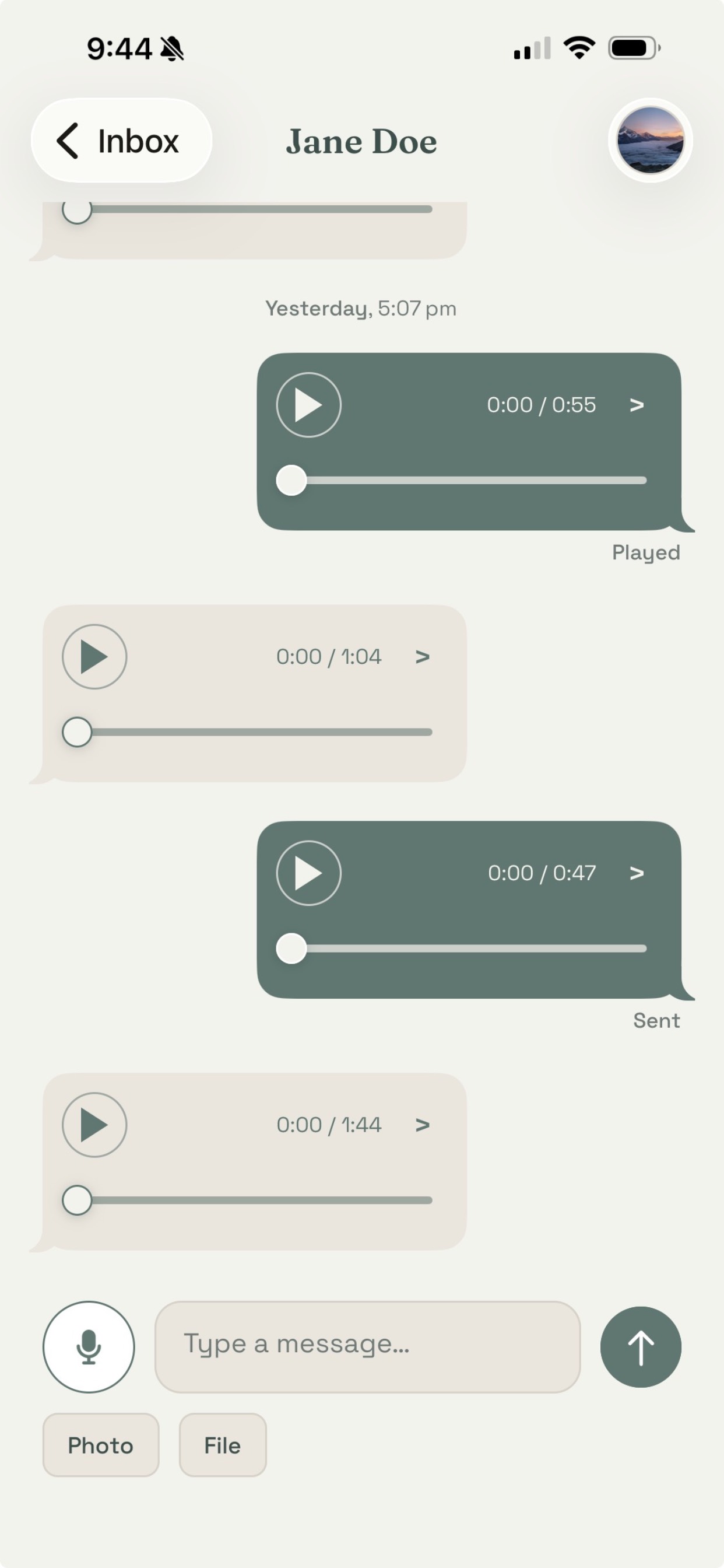
You use our purpose built app, Altum Cor, to share what arises across the week.
I respond each weekday, holding the therapeutic work across the days rather than compressing it into a single hour.
Your relationships, your choices, your inner life, your faith.

People seek out accompaniment therapy for many of the reasons that bring them to therapy generally — anxiety, depression, trauma, shame, grief, relationship difficulties, vocational uncertainty, emotional overwhelm, addictions and compulsions, the transformational work of becoming who you were made to be.

The model also fits people who are functioning well on the outside but carrying unresolved things within themselves, drawn to depth, willing to reflect between messages, and looking for an approach that respects their faith — whether faith is central, exploratory, or in difficulty.

It is not the right fit for those in acute crisis, those seeking only occasional advice or those needing real-time or after-hours response. If you are unsure, the free consultation is for exactly that.
Supported by
Altum is Latin for the deep and the heights. Cor is Latin for heart. Altum Cor is the secure, purpose-built communication platform through which Altum Accompaniment Therapy is delivered — designed specifically for sensitive therapeutic exchange.
Begin
A single conversation to talk through what you are carrying, what kind of support would help, and whether Altum Accompaniment Therapy is the right next step.
No obligation and no cost. If it isn't the right fit, I will tell you, and where I can, I will point you toward what is.
FAQ
Both approaches can be valuable. Altum also offers traditional fortnightly or monthly telehealth therapy, and for many people, that rhythm is the right fit.
Altum Accompaniment Therapy works differently because of its rhythm. Instead of reconstructing your week in a fifty-minute session, you send voice messages from within daily life. I respond each weekday, helping you notice patterns as they emerge, hold the therapeutic thread across the week, and the accompaniment helps turn insight into lived integration.
What makes the model genuinely powerful is the asynchronous nature of the dialogue. You speak when you are ready, often from inside the experience you are trying to make sense of. I listen carefully and respond with thought, not with the pressure of having to fill a live conversation. You then listen in your own time, whether on a walk, in the car, or late at night, and sit with it for as long as you need. Because the dialogue is recorded, you can listen back to a reflection that helped, return to something you didn't quite catch, or revisit a moment of insight days later when it suddenly makes sense in a new way.
Something is given up in this format: the immediacy of real-time presence. For many people, what is gained is far more valuable: an asynchronous deeply reflective space that creates safety and depth, where the hardest things are often easier to speak than they are face to face.
In my experience, this model can reach depths of healing in four to six months that traditional fortnightly therapy often takes one to two years to reach. For the right person, this deeply relational approach changes what is possible.
It is psychotherapy conducted through asynchronous telehealth, using recorded daily voice messages.
During my four years working full-time with the CatholicPsych Institute in New York, where I served as International Programs Director and Master Mentor and completed the CatholicPsych Model of Applied Personalism Certification (CPMAP), I came to deeply appreciate the value of asynchronous voice dialogue as a way of accompanying people daily in real life. CatholicPsych pioneered its Integrated Daily Dialogic Mentorship (IDDM) modality on that foundation: a clinically informed, non-therapy form of what they define as mentorship and a genuine innovation in faith-integrated care.
Asynchronous reflective dialogue itself is broader than any one program and older than any contemporary technology. Across the Christian tradition, spiritual directors, theologians, and friends have accompanied each other through reflective correspondence for centuries. St Francis de Sales conducted much of his direction of souls by letter, in dialogue that unfolded over weeks and years. Two centuries later, Venerable Bruno Lanteri, the Italian priest and founder of the Oblates of the Virgin Mary, sustained extensive spiritual accompaniment by letter through a turbulent age of war and revolution, encouraging his directees with patient hope and the conviction that one could always begin again.
Within psychotherapy itself, the value of written and reflective between-session contact has long been recognised. Carl Rogers reflected on extended client correspondence as part of his client-centred approach, and Michael White and David Epston formalised the therapeutic letter as a clinical intervention within narrative therapy in the late twentieth century. In more recent decades, asynchronous voice work has been used widely in executive coaching and other professional contexts, with the Voxer platform well established in that space. Asynchronous voice dialogue is the contemporary form of an old and well-tested rhythm of accompaniment, one that fits the way modern life actually runs rather than the constraints of a scheduled hour.
Altum Accompaniment Therapy carries the insights I gained at CatholicPsych and from this wider tradition into this modality of practice. It is delivered as asynchronous telehealth therapy by an Accredited Mental Health Social Worker, within the Australian privacy and regulatory environment.
The work is grounded in a Christian understanding of the human person and held together by two integrating frameworks: Interpersonal Process Therapy and the CatholicPsych Model of Applied Personalism (CPMAP).
Interpersonal Process Therapy provides the clinical spine. It focuses on the relational patterns that shape how a person experiences themselves and others. These are patterns formed early in life, often unconsciously, and lived out in present-day relationships, including the therapeutic relationship itself. Change happens through noticing these patterns, understanding their origins, and gradually responding from a freer place.
CPMAP informs my clinical practice in the way it brings together three concentrations into one coherent practice: a Catholic philosophical anthropology drawn from St John Paul II's personalism, traditional Christian spirituality informed by figures such as Fr Benedict Groeschel and the Ignatian tradition, and contemporary psychological science. The CPMAP model takes seriously that the human person is bio-psycho-social-spiritual, that relationship is the fundamental reality of human life, and that healing, integration, and growth happen as these dimensions are honoured together rather than treated in isolation.
Within this integrating frame, the work also draws on Acceptance and Commitment Therapy (mindfulness and working with what we can and cannot change, and acting from values), Narrative Therapy (helping you author your story rather than be authored by it), and Internal Family Systems (engaging with the different inner parts of yourself with compassion and curiosity).
These approaches are not applied in sequence or by formula. They are integrated and brought to bear with discernment, depending on what is alive in your story at any given moment: the patterns you are noticing, the work that needs doing, the season you are in. The constant across all of it is the relationship and the rhythm.
The frame is simple: you can leave up to fifteen minutes of voice messages each day, five days a week, and I respond each day within 24 hours. The fifteen minutes can be one longer message or several short ones, depending on what your day allows. Across a typical week this adds up to around 2.5 hours of reflective therapeutic dialogue. Across a month, roughly 10 hours or more.
Most clients spend fifteen to thirty minutes a day across recording, listening to my response, and reflecting. The model is designed to fit alongside the rest of your life rather than requiring you to step out of it.
There are no scheduled appointments and no waiting rooms. You record when the moment calls for it: between meetings, in the school pickup line, on a walk, late at night. Whether you are a parent in the thick of family life, a leader carrying a heavy week, or someone whose travel makes weekly sessions impossible, the model meets you where you are, no matter the timezone.
The standard frame holds for the great majority of the work, with two clinically considered exceptions. From time to time, if it is clinically useful, we can arrange a live telehealth session within your monthly engagement; this is an exception to the usual rhythm rather than part of it, and I make that judgement carefully. For clients who have been in accompaniment therapy for an extended period and are moving into a quieter, more integrative phase of the work, a lower-cadence option of two messages per week at a reduced fee is sometimes available. Places at this cadence are limited and only offered where I judge it clinically appropriate for that stage of your work.
I am Shawn van der Linden, an Accredited Mental Health Social Worker. I have spent more than thirty years working with people in the places where life is hardest to navigate, including clinical practice, pastoral leadership across Catholic Education and Archdiocesan settings, and senior roles across community, corporate, and international contexts. I am qualified in social work, family therapy, theology, and management. I served four years full-time as International Programs Director and Master Mentor with the New York-based CatholicPsych Institute, where I completed the CatholicPsych Model of Applied Personalism Certification.
Social work has a long tradition of meeting people where they are and building practice that the system has not yet caught up to. Altum Accompaniment Therapy stands in that tradition. It is evidence-informed, clinically governed, and grounded in a Christian understanding of the human person, offered to Christians, those without faith, and those somewhere in between, with the same care.
If we work together, you will not be a case or a caseload. You will be someone I know.
The fee is $1,600 AUD per month. Across a typical week, the model delivers around 2.5 hours of reflective therapeutic dialogue, roughly 10 or more hours of guided therapeutic work each month. Across many years of practice, I have seen this rhythm reach depths of healing in four to six months that traditional fortnightly therapy often takes one to two years to reach. For many people, the daily model makes the work shorter overall, not longer.
Alongside my clinical practice, I lead system-wide consultancy projects, supervision, and training work with Catholic dioceses, schools, religious orders, and mission-driven organisations across Australia. I deliberately hold a small number of accompaniment therapy places at any one time, so that each client receives the depth of attention the work requires.
If cost is a barrier and you feel genuinely drawn to this way of working, please raise it in the consultation. I hold a small number of discounted places for people with financial constraints, and I would much rather have an honest conversation about it than have cost be the reason you don't begin.
Generally I would encourage you to be ready to commit to at least three months. The rhythm of the model takes a little while to settle, and the real depth of the work usually begins to emerge once it has. On average, people stay in accompaniment therapy for around eight months. Some do three; others continue for two years or more, depending on what they are working through. It is a monthly subscription with no long lock-in. You discern continuation month by month.
Many people choose this model because they come to recognise that the cost of remaining stuck is often heavier over time than the cost of the work itself.
Missing a day is normal and not a problem. If you go quiet for a few days, we simply notice it together when we reconnect and explore what was happening for you. That itself is often part of the work.
One of the strengths of the model is that it can continue while you travel. Time zones and geography do not get in the way. Wherever you are in the world, you can keep recording when the moment calls for it, and I respond on my Australian weekdays as usual. A number of clients have found it deeply valuable to continue the work while on pilgrimage, retreat, or extended travel, where the reflective rhythm can hold and deepen what they are experiencing rather than pause it.
Planned absences, pauses, and the practicalities of ending well are all worked through carefully in the Customer Agreement and Informed Consent form you receive at the start. If you ever feel uncertain about continuing, I would encourage you to bring that into the dialogue rather than carry it alone; it is often a meaningful piece of the work.
The pace is guided by you. Although we are in contact each weekday, the work is contained and boundaried. There is a fifteen-minute daily limit on your voice messages, which most people find more than enough. There are no expectations on weekends. My role is to help you stay centred and to move at a pace that is safe and sustainable for the season you are in.
People sometimes worry the model will be too much before they begin, and then find the opposite. The steady rhythm is what makes deep work feel safer, not more overwhelming. You are not left holding hard things alone for a week at a time.
If at any point the work feels like more than the season can hold, we adjust together.
You are welcome here. I work with Christians for whom faith is central, with people who are exploring or wrestling, with people who have been wounded by the Church and don't know what they believe any more, and with people who have no faith at all. The work meets you where you are.
My approach is shaped by a Christian understanding of the human person, and I am open about that because every therapy is shaped by some view of the person, whether stated or not. But the integration of faith into the conversation only happens to the extent you want it. I will not impose, and I will not bracket out questions of meaning, dignity, or vocation if they matter to you.
Medicare rebates are not available for Altum Accompaniment Therapy. Medicare's rebate system for those with a Mental Health Care Plan from their GP is built around fifty-minute session-based therapy and does not apply to a subscription-based, asynchronous, high-frequency model. If Medicare-rebated therapy is important to you, Altum's traditional telehealth therapy is rebatable under a Mental Health Care Plan from your GP. I have a small number of places available for this work, sessions are $250, there is an $87 rebate back to you for 10 sessions per year, and I offer a free consultation as the first step in discerning if this is the right path for you.
For NDIS participants, accompaniment therapy can be funded in some cases where it aligns with plan goals, typically under categories such as Improved Daily Living or Capacity Building (Social and Community Participation). Eligibility depends on your plan and clinical fit. We can explore this in the consultation.
Yes. Not everyone wants the research detail, and that is completely fine. For those who do, here is what underpins the work. Altum Accompaniment Therapy is informed by several well-established streams of clinical research, each one supporting a component of how the model is designed and delivered. Taken together, they show that sustained, attuned, asynchronous therapeutic dialogue is a credible foundation for serious emotional, psychological and personal growth work.
The therapeutic alliance is the most reliable predictor of change. Across more than four decades of psychotherapy research, the strength of the relationship between client and therapist has consistently emerged as the single most robust predictor of positive outcomes, irrespective of theoretical orientation. The most comprehensive meta-analysis to date synthesised 295 studies involving more than 30,000 clients and confirmed this relationship as both consistent and substantial (Flückiger, Del Re, Wampold, and Horvath, 2018, Psychotherapy). Altum Accompaniment Therapy is structured to deepen the alliance by extending it across the rhythm of the week, allowing trust, attunement, and the internalisation of more secure relational patterns to build steadily over time.
Relational psychotherapies show strong outcomes. Interpersonal Psychotherapy, which informs the clinical spine of Altum Accompaniment Therapy, has been shown across meta-analyses involving thousands of clients to produce moderate to large reductions in depressive symptoms and meaningful gains in interpersonal functioning (Cuijpers et al., 2011, American Journal of Psychiatry; Markowitz and Weissman, 2004, World Psychiatry). Intensive Short-Term Dynamic Psychotherapy, which shares the model's conviction that relational depth drives change, has demonstrated large effect sizes for depression, anxiety, and interpersonal difficulties, sustained at follow-up (Abbass, Town, and Driessen, 2012, Harvard Review of Psychiatry).
Telehealth psychotherapy is as effective as in-person psychotherapy. A comprehensive meta-analysis directly comparing guided internet-delivered CBT with face-to-face CBT across thirteen studies found equivalent overall effects (Andersson, Cuijpers, Carlbring, Riper, and Hedman, 2014, World Psychiatry). A separate systematic review and meta-analysis found that videoconferencing psychotherapy produces clinical outcomes equivalent to face-to-face delivery and is capable of forming a working alliance comparable to in-person sessions (Norwood, Moghaddam, Malins, and Sabin-Farrell, 2018, Clinical Psychology and Psychotherapy).
The therapeutic alliance forms reliably in asynchronous, text-based therapy. A systematic scoping review of twenty-three studies of asynchronous text-based digital therapy found that strong working alliances were reliably established and were positively associated with treatment outcomes (van Lotringen et al., 2021, Frontiers in Digital Health). These findings directly support the use of asynchronous dialogue as a clinically credible therapeutic medium.
Daily digital contact is associated with faster, more sustained symptom reduction. A randomised micro-trial of daily CBT-informed text messaging found that participants experienced mood improvements within the first two to three weeks of the program (Arévalo Avalos et al., 2024, PLOS Digital Health). A meta-analysis of eighty studies involving more than 16,000 participants reported a pooled effect size of Hedges g = -0.61 in favour of digital psychotherapies for depression (Wu et al., 2024, JMIR Mental Health). More frequent therapeutic contact creates more frequent opportunities for intervention, reflection, and integration.
There is precedent for daily therapeutic contact in regulated psychotherapy practice. Dialectical Behavior Therapy includes structured phone coaching between sessions, and higher frequency of this between-session contact has been associated with stronger therapeutic outcomes in clients completing intensive DBT outpatient programmes (Edwards et al., 2021, Psychology and Psychotherapy: Theory, Research and Practice). Altum Accompaniment Therapy extends this principle into a sustained weekday rhythm.
Spiritually integrated therapy is effective and improves engagement. A meta-analysis of ninety-seven studies involving more than 7,000 clients found that spiritually integrated therapies are as effective as secular therapies for psychological distress and often produce greater gains in spiritual wellbeing and life meaning (Captari et al., 2018, Journal of Clinical Psychology). Accommodating client preferences, including for faith integration, has been associated with significantly reduced treatment dropout (Swift, Callahan, Cooper, and Parkin, 2018, Journal of Clinical Psychology).
What is innovative about Altum Accompaniment Therapy is not the therapy itself but the modality through which it is delivered. Much as the field moved from in-room sessions to video telehealth a decade or so ago, asynchronous telehealth is a similar next step: psychotherapy delivered through the rhythm of voice dialogue across the week rather than scheduled appointments. More information on the evidence-informed foundations of this approach is available on request.