
Listen to this article
Being held in the moment of loss
I was twenty one years old when my father called me with news that utterly changed my life. I can still hear the tone in his voice. There had been a car accident. My mother had been critically injured and it looked as though she would not survive.
I was interstate at the time. The week before, I had moved to Canberra to begin discerning religious life with the Missionaries of God's Love. Everything in my life had just begun to shift into a new direction, and within a single phone call that sense of direction gave way to shock and disorientation.
At that moment, I remember being held.
A good friend of mine, Father Dean Braun was the person who embraced me and remained with me as the weight of that news settled in. There are moments of trauma that mark you in a way that stays. This is one of them. He stayed close. He did not move away from the pain or try to organise it into something manageable. He just stayed with me in it.
That accompaniment continued well beyond that moment.
Father Dean had been an internationally renowned public speaker in the pre digital social media world of the 1980s and 1990s in the Christian Unity movement, regularly addressing massive crowds in football stadiums and conferences. He had a magnetic personality that radiated the love of God and brought healing and joy to many. This aspect of his giftedness was captured in the portrait of Father Dean painted by @paulnewtonartist.
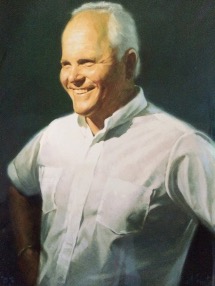
Fr. Dean Braun
† July 29, 199
Upon hearing the news about my mother, he travelled with me immediately to Melbourne so I could be with my family. In the days that followed, he celebrated a home Mass for our family and remained close to us, and then was at the funeral.
Over the following months, while I was back home, he continued to stay in contact in a simple and faithful way. Every Tuesday a letter would arrive (handwritten and snail mail) with words of encouragement, a prayer, or a brief reflection. Tuesdays became marked by that contact, the same day each week on which my mother had died.
The regularity of those letters gave shape to a time that otherwise felt uncontained.
Looking back, I can see how much those small acts mattered.
The grief that gripped me was intense and disorienting. There was no sense of resolution.
Yet the relationship he maintained with me created enough steadiness for me to begin the process of making meaning out of the trauma.
That experience has remained with me.
It has profoundly shaped how I understand healing, and how I work. It taught me, more than any books or academic learning ever could, that healing unfolds within relationship.
Walking with Father Dean through illness
Years later, it was my turn to walk closely with Father Dean through his own suffering. He was diagnosed with cancer, and underwent aggressive treatment, which included bone marrow transplants and chemotherapy that stripped his body of strength and dignity.
During that time, he and I had conversations where he spoke with such raw anger. He expressed how at times, he felt abandoned. He felt frightened and made no effort to disguise it in pious language. Serious illness dismantles our illusions of self sufficiency. It exposes how much of our identity is built on competence and assumed tomorrows. When those foundations crack, something in us resists and our protective parts start to mobilise, seeking certainty and demanding explanations.
I watched him move through these stages over time. After years of treatment he entered into a period of remission that lasted three years. Outwardly, life resumed its familiar rhythm and his joy returned as he resumed being a parish priest.
He was the same man, however he seemed now to inhabit himself more fully.
The experience of illness had taken him to the limits of his control. He had faced the possibility of death directly. He had lived through anger and fear in their full intensity. Over time, the way he carried himself changed: there was a peace in him that had not been there before.
His prayer life also profoundly shifted. He described it as simpler, more immediate, more like a natural communion that he could enter without effort.
Within the Christian spiritual tradition, this kind of prayer emerges as a gift when a person has passed through deep darkness and has come to a place of deeper reliance, surrender, and dependence on God.
This was visible in him.
He spoke to me about sitting on the back porch of his presbytery in the Illinois farming community where he lived. He would watch the movement of the animals, the rhythm of the land, the ordinary activity unfolding around him. At some point, without intending to, he would find himself drawn into prayer and contemplation. Two or three hours would pass at times. He would only realise the passage of time afterwards.
What I witnessed in him was a man reconciled to his limitations. The striving had eased. His sense of identity rested in communion rather than in productivity or strength. His relationship with God had taken on a simplicity that no longer depended on effort or structure.
When I think of Father Dean during those years of remission, it is clear that his earlier anger and desperation had been brought into a wider integration. He had faced his fear of death and his lack of control directly. In consenting to those limits, he became more able to see, receive and remain present to the gift of life and love of God.
Recognising the same pattern in ourselves
I recognise the same pattern in my own life.
There are periods, even now, where a kind of dullness starts to dominate. Nothing dramatic needs to have happened; no crisis or obvious loss. I notice myself moving through the day preoccupied, scanning, slightly tense, thinking about what might go wrong. I start to manage outcomes internally, rehearsing conversations that may never occur.
In those moments, I can feel how far away gratitude is from me.
What is actually moving in me is anxiety. My body tightens and my attention narrows. I start scanning for what might go wrong. My mind moves quickly toward what needs to be managed or controlled. It becomes harder to receive what is in front of me because I am already bracing against what might come next.
In my clinical work I see this pattern repeatedly.
A father who was shamed as a boy finds himself erupting at his own child. He describes the look in his son's eyes when he loses control. Beneath the anger there is an exiled part carrying humiliation that was never named. His anger functions as a protector that keeps him from re-experiencing that sense of smallness.
A woman whose early attachments were unreliable becomes vigilant in her marriage. She monitors tone, timing, and subtle changes in her husband's mood. Anxiety organises her behaviour. The part of her that fears abandonment shapes the relationship. The strain is felt by both of them.
These patterns reflect wounds that have not yet been integrated. What remains outside our awareness continues to express itself through our behaviours and relationships. Pain gradually shapes our tones, postures, and expectations.
The Gospel entering human suffering
The Gospel speaks directly into this reality.
Luke records that from the cross Jesus said, "Father, forgive them; for they know not what they do" (Luke 23:34). He names the harm and entrusts it to the Father. His response interrupts the continuation of violence.
John writes, "Standing by the cross of Jesus were his mother..." (John 19:25). Mary remains in relationship. Her stance reflects an enduring attachment to both her Son and the Father in the midst of what cannot be changed.
The inmost being of each person remains marked by the image of God, even when dominated by defensive patterns. Grace enters the wound and works within it. The risen Christ shows his wounds to Thomas (John 20:27). They remain visible and become places of encounter.
In therapy, the transformation of pain takes place through concrete processes. We slow down. We notice when a reactive part has taken over. We distinguish between protective responses and the underlying wounds they guard. We allow grief to be felt in the body without rushing to resolve it. We bring these experiences into relationship where they can be held and understood. Over time, a steadier centre begins to emerge.
I continue to notice how quickly I move to manage discomfort. I move toward solutions. I move toward clarity. With time, I have come to see that control holds pain in place without transforming it. Transformation occurs when truth is faced within relationship.
Bishop Erik Varden captures this whole process of transformation well in his book Healing Wounds:
Our wounds will finally heal when they have become so one with Christ's, so fully surrendered, that we no longer know where his passion ends and ours begins. We are caught up, then, in the inexorable victory of his life over our death, of his light over our darkness, of his wholeness over our fragmentation. United with him in death, we are drawn into his life, over which human mortality and sickness have no power. The process takes time. The anguish is real before the prospect of broadness opens. But sooner or later we no longer look into the darkness of the cleft in which the dove hides, but out of it. We see, then, a world infinitely loved, transfigured, worthy to be loved. (p. 172).
Why pain can be transformed
Pain is part of every human life.
The question that follows concerns how that pain is received and expressed. A person can organise themselves around it, or allow it to be brought into relationship where it can be named and gradually integrated.
This work unfolds slowly and often remains unseen. It takes place in conversations behind closed doors, in prayer that feels dry, in the decision to relate differently to what has been carried.
When I look back now, I can see that the accompaniment Father Dean offered me during my own grief reflects the same movement that later became visible in his life.
What he showed me in those early days was a way of staying with pain that did not collapse under it.
I saw the weight of illness on him. I saw the exhaustion and the anger that accompanied it. I also saw the gradual work of grace as he yielded to what he could not control. The transformation of pain rests within the reality of Christ's death and resurrection.
Christ has entered into suffering fully. He has carried it through death and into new life. The wounds remain, and they now carry a different meaning within that movement.
This gives a horizon to our own suffering.
What we carry is not sealed or final. It can be brought into relationship with God and with others. It can be spoken, held, and gradually reshaped.
This takes time. It unfolds through grace and through real relationships.
I have seen it in my own life. I saw it in Father Dean.
This possibility is open to each of us as well.