
In the liturgical readings this week, we hear the beginning of Mark 8, and then the story is interrupted by Ash Wednesday. But the Gospel does not end where the reading stops. If we continue reading and behold the whole scene, Mark 8:11 to 26, we can encounter a story with profound resonance on the nature of healing and the slow work of accompaniment.
Mark tells us, “The Pharisees came and began to argue with him, seeking from him a sign from heaven, to test him” (Mark 8:11).
They want proof: something decisive and immediate.
Jesus’ response is deeply human. “And he sighed deeply in his spirit, and said, ‘Why does this generation seek a sign? Truly, I say to you, no sign will be given to this generation’” (Mark 8:12).
He sighs from the depths of his spirit.
There is grief in that sigh: grief at our demand for shortcuts and our reluctance to trust the slow work of grace.
We are not so different from the Pharisees. We also want signs and want healing to be efficient. We want anxiety gone, patterns broken, relationships restored, preferably quickly.
In therapy I often meet that longing. Beneath the surface clients have a hope that perhaps there is a technique, a single insight, or a decisive spiritual experience that will fix everything.
But deep calls on deep (Psalm 42:7). The heart of God for us is not a spectacle; it is a relationship, and relationships cannot be rushed.
The Pharisees resist because Jesus threatens their arrangement of the world. To welcome him means real and uncomfortable change: “No sign will be given,” he says, and then “he left them, got into the boat again and went to the other side” (Mark 8:13).
Christ does not perform on demand.
He turns instead to his disciples and warns them, “Watch out, beware of the leaven of the Pharisees and the leaven of Herod” (Mark 8:15).
Our defenses and self-righteousness can spread quickly and invisibly, like leaven. The parts of us that prefer the familiar to change can be like this too.
The disciples misunderstand him; they think he is talking about bread. Jesus responds almost painfully: “Why do you discuss the fact that you have no bread? Do you not yet perceive or understand? Are your hearts hardened? Having eyes do you not see, and having ears do you not hear?” (Mark 8:17 to 18).
Having eyes, do you not see?
Even the disciples, who walk with Jesus, carry this blindness in their hearts: an instinctual resistance to trusting the Lord. In the healing journey this becomes very real. We can know the right answers, and speak the language of faith and growth. But when it comes to letting go of control and the identity built around our wounds, we often hesitate.
We too carry an inner Pharisee: a part that resists change, and demands certainty before surrender.
The story moves on.
“They came to Bethsaida. And some people brought to him a blind man and begged him to touch him” (Mark 8:22).
He does not come alone. Others bring him. No one heals alone; healing is relational.
“And he took the blind man by the hand and led him out of the village” (Mark 8:23).
That detail is important. Jesus leads him away from the crowd, the noise, and the familiar environment that has defined his blindness.
Our Lord is so tender here. Christ holds the hand of a blind man and guides him into a quiet place. This is the heart of accompaniment and it should be at the heart of all therapy and counselling.
Healing rarely happens in the middle of the familiar village. It happens in intentional and often unfamiliar places in the therapy room, in spiritual direction, in prayer. We need relationships where we are safe enough to actually be seen.
Jesus touches his eyes and asks, “Do you see anything?” (Mark 8:23).
The man replies, “I see people; but they look like trees, walking” (Mark 8:24).
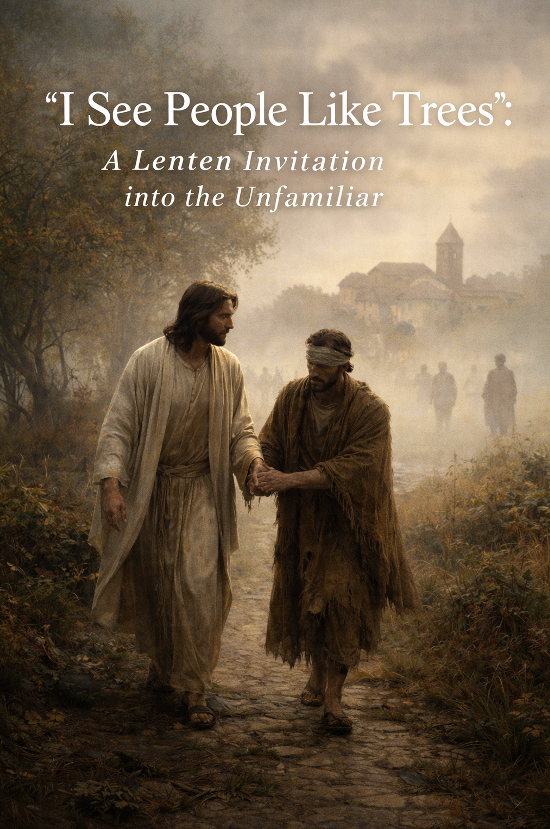
He can see, but not clearly.
What a vivid representation this is of how healing unfolds.
There is a moment in therapy when something shifts, as when a person recognises a pattern, or understands a moment when the shame began and became internalised or exiled away within. He or she sees how a protective part of themselves has been managing their world, and gets a glimpse at his or her inmost being, the image of God within and how this is differentiated from other younger parts.
But it is blurry. They still react, and fall into old habits, and still feel confused at times.
Therapy is healing, and healing can feel slow, painful and frustrating. This is stage one.
“Then Jesus laid his hands on his eyes again; and he looked intently and was restored, and saw everything clearly” (Mark 8:25).
The miracle happens in stages.
Christ could have healed him instantly. But here he does not. The loving will of God for this man in this moment is a gradual transformation, with some strange but beautiful intermediary stages in the healing process.
The apostles themselves are slow to see. The blind man is slow to see. We are also slow to see.
Integrated therapy and spiritual accompaniment participate in this same methodology. We step outside the village, allow ourselves to be led by the hand, and permit the first touch, even when our vision is still unclear.
Lent is precisely this journey. As we head into this season, perhaps God’s invitation to us is not to demand a sign, but to accept a tangible hand and become open to the unfamiliar ways and stages of healing that the Lord has in mind for us.
We can let the Word touch the places of confusion and defence within us. “Rend your hearts,” the prophet Joel tells us, “and not your garments.” In this season, the work is interior: allowing Christ to ask us gently, “Do you see anything?”