
Listen to this article
Very often in my practice I sit with parents and grandparents who whisper the same quiet confession, “I never thought this would happen to my family”.
They say it softly. Sometimes with disbelief. Sometimes with the kind of grief that sits unspoken in a culture where family life has become fragmented and fragile. Some have been told very clearly that their adult child needs space. Others have been cut out without any explanation at all. Some have never held their grandchildren. Others live with a silence that grows heavier with each passing month.
In the gentle heartbreak of these stories I have begun to notice a pattern. Estrangement has always existed, yet something feels different now. We are living in a moment in which relational cutoff has become really normalised. Even expected and encouraged. I see it in the therapy room. I see it in the teams and institutions I support. I see it in the homes of parents who never imagined they would be strangers to their own children.
The cultural tide we are standing in
During the past two decades our understanding of relationships has been reshaped by cultural stories that most of us did not even realise we were absorbing. Ideas that once lived quietly in academic spaces have now become the background music of social media, podcasts and self help culture.
We have learned to question authority. That has been important in many ways. Yet we have also learned to examine every relationship through a lens of power and harm. Once that becomes the only lens, even the ordinary tensions of family life can look unsafe.
Young adults have grown up swimming in psychological language. Words like trauma, toxicity, narcissism and gaslighting are spoken with fluency. I am grateful people feel freer to name their pain. Yet I also see how easily these words expand beyond their original meaning. When discomfort is treated as harm, the threshold for staying in a challenging relationship becomes very low.
Haidt and Lukianoff speak to this directly in The Coddling of the American Mind, their careful and compelling exploration of how a generation came to equate emotional challenge with danger:
“A culture that allows the concept of ‘safety’ to creep so far that it equates emotional discomfort with physical danger is a culture that encourages people to systematically protect one another from the very experiences embedded in daily life that they need in order to become strong and healthy.”
Social media intensifies everything. A moving tik tok about cutting off a parent can gather millions of likes. A post naming liberation from a family dynamic becomes a script for others. And to be clear, the algorithms amplify this messaging like rocket fuel on a fire. The cultural message is simple. If something hurts, distance yourself. If something confuses you, step away. If someone fails you, start again somewhere else.
Of course some separations are absolutely necessary. Abuse and danger are real. But we are also living in a moment where separation is often presented as the most mature or enlightened response. When that becomes the dominant story, families lose the imagination for repair.
The quieter forces shaping all of us
There are other forces at work as well. Less dramatic. More quiet. More woven into the texture of daily life.
We live overstimulated and sedated at the same time. Constantly connected yet strangely disconnected. A missed message that once meant nothing now stirs anxiety. The digital tether lifts the emotional temperature of every relationship until ordinary interactions feel charged.
Alongside this, many young adults have a level of independence that no generation before them enjoyed. When survival no longer depends on the family unit, the natural motivation to push through relational messiness fades. Independence is a genuine gift. Yet it can also tempt us to curate lives where patience and forgiveness are unnecessary. And when the mirage of connection offered by social media, gaming or pornography provides just enough dopamine to quiet the need for real intimacy, the hard work of deepening relationship feels avoidable.
When community becomes optional, relationships grow fragile. Difficult people become replaceable. The emotional muscle needed for reconciliation slowly weakens.
What unfolds inside the relationship
Most estranged parents tell me the same thing. It felt sudden. One moment the relationship seemed manageable. The next moment they were living in a story they did not recognise.
Often something unresolved from the past begins to be reinterpreted through a very individualistic, highly psychological lens. Old memories are reviewed. Motives are questioned. The ordinary imperfections of parenting are reframed as fatal flaws.
If the relationship did not have safe rhythms of communication, or if the adult child never felt fully heard, the reinterpretation gains momentum. The story inside them hardens. Then the message arrives. Or the silence begins.
Parents are left bewildered. They often blame one single moment. I want to gently say the truth is almost always more complex. Estrangement usually grows from a mixture of unspoken pain, cultural influence, misunderstandings and a lack of restorative pathways.
This is not about fault. It is about clarity. Because once we can name the map, we can walk it differently.
A restorative way of thinking
My work in restorative practice has shaped how I understand relational rupture. Working with families and workplace teams to rebuild trust, again and again I have seen the same truth.
Relationships matter. And when something breaks, we need a way to come together rather than drift apart.
Restorative thinking and practice begins with simple human commitments: empathy, accountability, listening, shared understanding and concrete steps forward. These principles can heal situations that look impossible. They are deeply relevant to family estrangement.
Even when your adult child is not ready for conversation, adopting a restorative mindset steadies you. It keeps your heart open. It protects you from despair.
The Social Discipline Window: a map for navigating through the struggle
When families reach the point of cutoff they often feel lost. They know something has gone wrong but cannot see the path that led them there. The Social Discipline Window offers a simple map. It names the different postures we fall into when conflict or stress rises and it helps us understand what happened, what is happening now and what needs to happen next.
The model describes how every response combines two ingredients. The first is the level of expectation or accountability we place on the relationship. The second is the level of emotional support we offer.
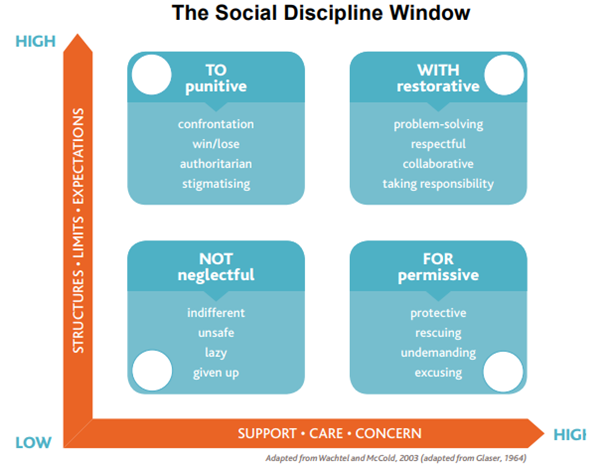
When both are low, the relationship slips into neglect. Difficult moments are avoided and everyone quietly hopes problems will resolve on their own. When support is high but accountability is low, the posture becomes permissive. Parents tiptoe, absorb the tension and expect very little in return. When accountability rises without support, frustration takes over and the interaction becomes punitive. This is the moment when adult children often feel criticised or unsafe.
Families who find themselves in cycles of cutoff have usually moved through these three postures without realising it. Avoidance, over accommodation and then a burst of frustration. None of this makes anyone a bad parent or a bad child. It simply shows how the emotional pattern unfolded.
There is one posture that allows repair. It is the posture where support and accountability sit together. The with posture. The space of restorative relationship. It asks us to speak truth with gentleness and to offer care without losing clarity. It is the place where connection and responsibility can breathe at the same time.
Seeing this model gives many parents new awareness. They begin to understand how the relationship drifted and they see a direction for the future. Even when the other person is not ready to talk, you can begin to inhabit the with posture now. You can hold steady expectations, stay open in heart and create the conditions in which reconnection becomes possible.
A practice guide for the slow work of restoration
Repairing a fractured relationship with an adult child is not something we rush. The work begins far beneath the surface, long before the first conversation is attempted. It begins with a slow turning of the heart. A willingness to prepare yourself for a new kind of encounter. A conversation shaped not by defensiveness or fear, but by clarity, empathy and shared responsibility.
Take time to reflect gently on your own experience. Let yourself name what happened from your point of view. Name how it has affected you emotionally. Name the ways you may have contributed to the hurt, not in order to blame yourself, but to see the whole story with honesty. Then let yourself wonder about your intention. Not the intention you think you should have, but the truest one. Perhaps you want the relationship to feel safe again. Perhaps you want to understand one another better. Perhaps you simply want to begin again.
This interior work grounds you. It steadies your nervous system. It prepares you to meet your son or daughter with a clearer and more compassionate presence.
Making room for their story
As you sit with your own story, begin to imagine the story they might be carrying. What might the experience have been like from their perspective. What thoughts and feelings were moving through them at the time. How might they have been affected by the same events in ways you did not fully understand. What has been the hardest part of this for them. Who else in their life may have been impacted.
Holding their story does not mean agreeing with their interpretation. It simply means recognising their humanity. When both stories can be held together, a doorway opens for genuine dialogue.
Extending a gentle invitation
When you feel ready, and only when you feel ready, you might consider opening a small and gentle invitation. This is not a push. It is not an attempt to force a moment of reconciliation. It is a soft reaching toward the other person. You might say something like, I sense there has been tension between us and I care about you. When you feel ready, I would welcome a conversation about how we are both feeling and how we might move forward.
This kind of invitation reassures the other person that they are free. It communicates safety. It places no pressure on the outcome. It simply signals your willingness to engage with maturity and tenderness.
When a conversation becomes possible
If your adult child becomes willing to talk, it helps to move slowly and with structure. Try to create a space where both of you can speak honestly about what has happened. Begin with simple human questions. What happened from your point of view. What were you feeling at the time. How has this experience affected you. What has been most painful or confusing. What do you believe needs to happen now for us to move forward in a healthier way.
These questions are not a script. They are an invitation into truth. They help both people resist the temptation to argue and instead describe the inner landscape of their experience.
Working toward resolution
As you listen to each other, certain needs will become clearer. A boundary that requires respect. A misunderstanding that needs correction. A pattern of communication that needs to soften. At this point it can help to gently ask, considering everything we have shared, what might help us feel more at peace with one another. What might move us a step closer to healing.
This is not the moment to fix everything. It is the moment to co create small, meaningful actions that honour both hearts.
Establishing commitments
Once these small actions emerge, give them shape. Speak them aloud. Let each person express what they are willing to commit to in the relationship. It may be a commitment to communicate feelings more openly. A commitment to listen without interrupting. A commitment to acknowledge hurt or offer apology when needed. A commitment to work on a specific behaviour that has contributed to the rupture.
These commitments are not contracts. They are signs of good will. They form the beginnings of trust.
Following up with gentleness
Healthy change requires return. Set a time, even a small one, to check in again. This allows you to review how things are unfolding and to honour the commitments you have made. Perhaps you meet in a couple of weeks. Perhaps you exchange a message about how things are feeling. The rhythm of return reinforces that the relationship matters.
Along the way, there will be challenges. Moments of resistance. Moments when emotions rise quickly. If the conversation feels overwhelming, pause. Take a short break. Begin again when both hearts are calmer. If someone slips back into an old pattern, gently remind each other of what you committed to and try again. This is the quiet courage of restorative relationship.
When the waiting continues
Not every parent will arrive at the moment of conversation. Some will remain in the long ache of silence. If that is your reality, please know that the work is still worth doing. Your growth is not wasted. You can still cultivate clarity, empathy, steadiness and responsibility. You can still become a person capable of reconciliation even if the other is not yet ready.
This posture protects your heart. It keeps you free from bitterness. It holds you in hope without denying the grief you feel. It allows you to live with peace even when the situation remains unresolved.
You do not have to walk this road on your own
Estrangement touches the deepest fibres of the human heart. It is a grief that many carry quietly, without language, without ritual, without community. If this is your experience, I want to offer you accompaniment. In my work at Altum Integrated I walk with parents and grandparents through reflective preparation, restorative coaching, facilitated conversations when appropriate, and therapeutic support for the pain of cutoff. For those who seek a faith informed pathway, we explore how grace can shape the journey toward healing.
You do not need to reach the destination today. You only need to take one steady step. When you are ready, I would be honoured to walk with you.